



Eco-Friendly Supplement Packaging: A 2026 Guide

Table of Contents
- What Sustainable Supplement Packaging Actually Means
- Recyclable Supplement Bottles: Materials That Close the Loop
- Compostable Supplement Packaging: When Biodegradable Makes Sense
- Refillable Vitamin Containers: Reducing Packaging Waste at Scale
- Eco-Friendly Packaging Materials for Supplements: Trade-Offs That Matter
- How to Choose the Right Sustainable Packaging for Your Needs
- Common Mistakes When Selecting Sustainable Supplement Packaging
- Frequently Asked Questions
Last Updated: October 16, 2026
What Sustainable Supplement Packaging Actually Means
Eco-friendly supplement packaging is packaging designed to minimize environmental impact across its entire lifecycle, from material sourcing through end-of-life disposal. It prioritizes recyclable, compostable, or reusable materials while maintaining the product protection your vitamins and minerals need.
The key distinction: sustainable packaging doesn't sacrifice shelf life or safety. A bottle that protects your supplements from moisture and light while being recyclable is sustainable.
At Nourishing World, we understand that choosing eco-friendly supplement packaging means balancing three competing demands: environmental responsibility, product integrity, and real-world disposal infrastructure. Most guides skip the last part entirely.
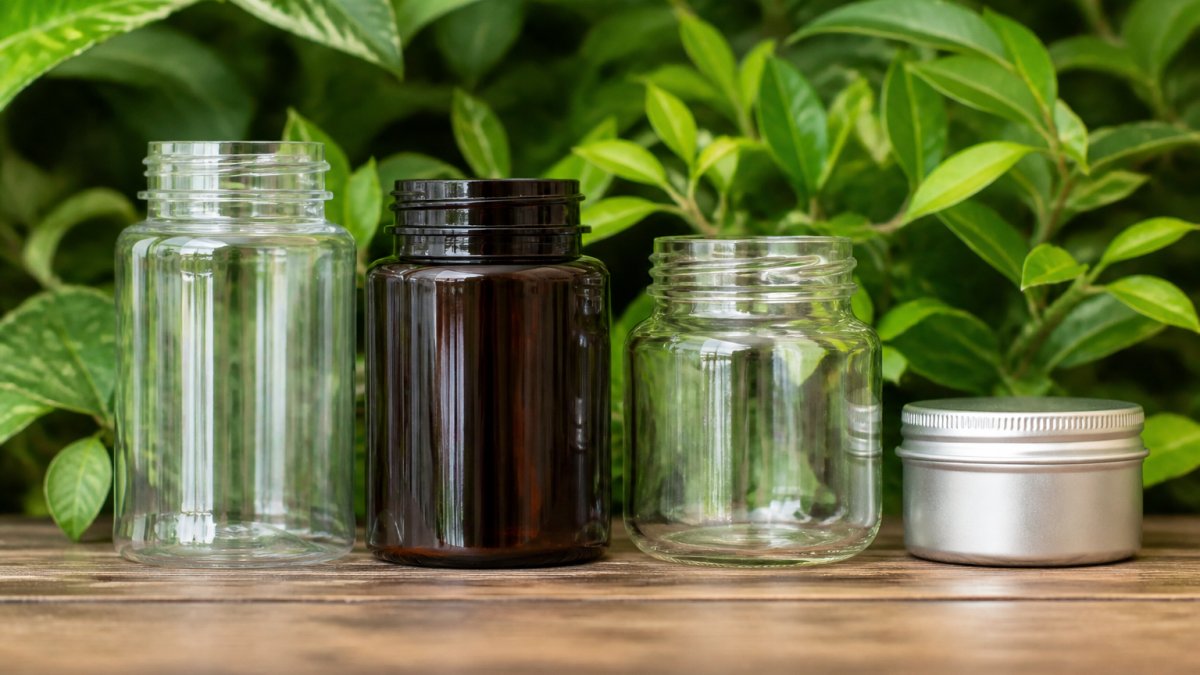
The materials you'll encounter fall into three categories: recyclable (PET, HDPE, glass, aluminum), compostable (paper, cardboard, some plant-based films), and refillable (glass jars, metal containers). Each has genuine trade-offs.
Recyclable Supplement Bottles: Materials That Close the Loop
Recyclable packaging closes the material loop, theoretically. In practice, recycling rates vary dramatically by material type and geography. A bottle recycled in one city might end up in a landfill in another.
PET and HDPE plastics
PET (polyethylene terephthalate) and HDPE (high-density polyethylene) are the workhorses of supplement packaging. PET is the clear plastic in most vitamin bottles. HDPE is the opaque amber bottle many prefer for light-sensitive supplements.
Both materials are widely accepted in curbside recycling programs across North America and Europe. They're shatter-resistant, lightweight, and cost-effective to manufacture. PET recycling is particularly well-established, it's one of the most recycled plastics globally.
The catch: recycling doesn't equal infinite reuse. PET and HDPE degrade slightly with each recycling cycle. After 4-5 cycles, the plastic loses structural integrity.
For supplements, HDPE offers better product protection. It blocks more light wavelengths than PET, keeping fat-soluble vitamins and omega supplements stable longer.
Glass containers
Glass is infinitely recyclable without quality loss. You can recycle glass 100 times and it performs identically each time. That's genuinely sustainable.
Glass also provides superior product protection. It's impermeable to oxygen and moisture, creating a true barrier against degradation. Supplements in glass last longer and maintain potency better than those in plastic.
The downsides are real: glass is heavy (higher shipping emissions), breakable (higher damage rates), and more expensive to produce. A glass bottle costs 2-3 times more than equivalent plastic. For consumers, that translates to higher product costs.
Glass makes sense for premium supplements, high-value formulations, and customers willing to pay for durability. It's less practical for budget-conscious consumers or large-volume products like protein powder.
Aluminum packaging
Aluminum is highly recyclable (infinitely, like glass) and lightweight, making it efficient to ship. Aluminum cans and tins are among the most recycled materials globally, with recycling rates exceeding 50% in many developed markets.
Aluminum also provides excellent barrier properties, it blocks light, oxygen, and moisture nearly as well as glass. It's durable, reusable, and doesn't degrade with repeated recycling.
The trade-off: aluminum production is energy-intensive. Mining and refining aluminum requires significant electricity. However, recycled aluminum uses 95% less energy than virgin aluminum, so high recycling rates make aluminum genuinely sustainable.
Aluminum works well for smaller supplements (capsules, tablets) packaged in tins or blister packs. For powders and larger quantities, aluminum becomes impractical due to size constraints.
Compostable Supplement Packaging: When Biodegradable Makes Sense
Compostable packaging breaks down into natural materials in a compost environment. The challenge: most supplements are packaged in materials certified for industrial composting, which requires specific temperature and microbial conditions found only in commercial facilities.
Paper and cardboard options
Paper and cardboard packaging are genuinely compostable in most settings. They break down in backyard compost, municipal compost, and industrial facilities. They're also recyclable, giving them a second life if composting isn't available.
Paper-based packaging works well for tablets and capsules, which don't require moisture barriers. Cardboard boxes for supplement bottles are increasingly popular, the box is compostable, and the inner bottle can be recycled separately.
The limitation: paper and cardboard don't protect moisture-sensitive supplements. Protein powders, greens powders, and any hygroscopic supplement (one that absorbs water) will degrade in paper packaging.
Paper packaging also costs more than plastic and offers less design flexibility. Printing and structural options are limited compared to plastic bottles.
Real-world composting availability
Here's where compostable packaging often fails in practice: access.
Most compostable supplement packaging is certified for industrial composting only. These facilities operate at 55-65°C with controlled moisture and aeration. Your backyard compost rarely reaches these temperatures. Home composting takes 12-24 months for certified compostable materials to break down, versus 3-6 months in industrial facilities.
In the US, only about 500 industrial composting facilities exist, concentrated in California, the Northeast, and a few other regions. If you live outside these areas, "compostable" packaging will sit in a landfill alongside regular trash, where it breaks down just as slowly as plastic.
Before choosing compostable packaging, check whether industrial composting is available in your area. Search the Composting Council database for facilities near you. If none exist within 50 miles, compostable packaging provides no real environmental benefit.
Refillable Vitamin Containers: Reducing Packaging Waste at Scale
Refillable systems eliminate the need for new packaging with each purchase. You buy a durable container once, then refill it repeatedly.
The model works like this: purchase a premium glass or metal container, then order supplement refills in minimal packaging (often a kraft paper pouch or cardboard box).
Refillable systems require infrastructure: a return-and-refill program, or at minimum, standardized containers customers can refill themselves. This works well for supplement brands with direct-to-consumer sales and customer loyalty.
For consumers, refillable containers make sense if you buy the same supplement regularly. If you're constantly trying new products, single-use packaging might be more practical.
The environmental math is straightforward: a glass refillable container used 10 times generates far less waste than 10 single-use plastic bottles.
Eco-Friendly Packaging Materials for Supplements: Trade-Offs That Matter
Choosing sustainable packaging means accepting trade-offs. No single material excels at everything.
Shelf life and product protection
Supplements are sensitive products. Vitamins degrade under light, heat, and oxygen exposure. Minerals oxidize. Oils go rancid. Protein powders absorb moisture and clump.
Here's the protection hierarchy:
- Glass and aluminum: excellent barriers, longest shelf life (2-3+ years)
- HDPE plastic: good barrier, solid shelf life (1-2 years)
- PET plastic: adequate barrier, moderate shelf life (1-2 years)
- Paper and cardboard: poor barrier without lining, shorter shelf life (6-12 months)
If your supplement contains vitamin A, vitamin D, omega-3s, or probiotics, you need a material that blocks light and oxygen. That typically means glass, aluminum, or HDPE, not paper.
The sustainability question becomes: is it more sustainable to package a supplement in plastic that keeps it stable for two years, or in compostable paper that requires replacement in six months because the product degraded?
Lifecycle impact and certifications
True environmental impact requires looking at the entire lifecycle: raw material extraction, manufacturing, transportation, use, and end-of-life.
A lightweight plastic bottle shipped 1,000 miles generates fewer transport emissions than a heavy glass bottle shipped the same distance. But glass lasts longer and recycles infinitely. The math depends on how many times the container is used.
Certifications like Cradle to Cradle or EU Ecolabel indicate that a material's full lifecycle has been assessed. These certifications require third-party verification, not just manufacturer claims.
Greenwashing is common in supplement packaging. A brand might use "eco-friendly" language while shipping in virgin plastic with no recycling infrastructure in place. Look for specific certifications, not vague environmental claims.
Cost and minimum order quantities
Sustainable packaging typically costs more than conventional plastic. Glass costs 2-3x more per unit. Compostable materials cost 20-50% more. Refillable systems require upfront investment in durable containers.
These costs are passed to consumers. A supplement in sustainable packaging costs more than the same supplement in basic plastic.
Minimum order quantities also matter. Many sustainable packaging suppliers require orders of 10,000+ units to offer competitive pricing. Small brands and startups can't access these economies of scale, making sustainable packaging prohibitively expensive.
If you're choosing a supplement brand, understand that truly sustainable packaging often means higher prices. Budget options rarely offer genuine sustainability, they offer the appearance of it.
How to Choose the Right Sustainable Packaging for Your Needs
Start with your supplement type. Different formats require different protection.
Matching packaging format to supplement type
Tablets and capsules are relatively stable. They don't require maximum barrier protection. Paper, cardboard, or lightweight plastic works fine. You can prioritize recyclability and cost.
Powders (protein, greens, pre-workout) are hygroscopic. They absorb moisture and degrade quickly. They need a moisture barrier: HDPE plastic, glass, or aluminum. Compostable paper packaging will fail.
Liquids and oils require the strongest barriers. Glass or aluminum are practically mandatory. Plastic works but offers shorter shelf life.
Probiotics and sensitive formulations need light barriers. Amber HDPE or glass. Clear plastic won't work.
Match the packaging to the product's actual needs first. Sustainability comes second.
Verifying environmental claims
Brands often make vague claims: "eco-friendly," "sustainable," "green," "natural packaging." These words mean nothing without specifics.
Ask these questions:
- Is the material recyclable in standard curbside programs? (Check your local recycling guidelines.)
- If compostable, is it certified for industrial or home composting?
- What percentage of the packaging is recycled content versus virgin material?
- Has the full lifecycle been assessed by a third party?
- Is there a take-back or refill program?
Legitimate sustainability requires transparency. Brands hiding behind vague language are greenwashing.
Common Mistakes When Selecting Sustainable Supplement Packaging
Prioritizing appearance over function. A beautiful compostable pouch that degrades your supplement in three months isn't sustainable. Function comes first.
Assuming all recycling is equal. Recycling rates vary by material and location.
Ignoring shipping impact. Heavy glass bottles generate significant transport emissions.
Buying based on marketing language. "Eco-friendly," "green," and "natural" are marketing terms, not certifications. Look for specific third-party certifications instead.
Choosing cost over durability. Cheap sustainable packaging that fails quickly generates more waste than durable conventional packaging. Durability is sustainability.
Choosing sustainable supplement packaging means accepting complexity. There's no single "best" option, only trade-offs that make sense for your specific supplement, budget, and values.
At Nourishing World, we prioritize supplements packaged in materials that genuinely protect product quality while minimizing environmental impact.
| Packaging Type | Best For | Recycling | Cost | Barrier Protection |
|---|---|---|---|---|
| HDPE plastic | Light-sensitive vitamins | Widely accepted | Low | Good |
| PET plastic | General supplements | Widely accepted | Low | Adequate |
| Glass | Premium, long-term storage | Infinitely recyclable | High | Excellent |
| Aluminum | Capsules, small formats | 50%+ recycled | Medium | Excellent |
| Paper/cardboard | Tablets, blister packs | Compostable | Medium | Poor |
| Refillable containers | Loyal customers, bulk | Minimal waste | Medium upfront | Excellent |
Frequently Asked Questions
What makes eco-friendly supplement packaging actually recyclable?
Recyclable supplement packaging must be accepted by your local recycling program and designed to be processed without contamination. PET and HDPE plastics, glass, and aluminum are widely accepted, but packaging must be clean and free of residue. Check your local recycling guidelines, not all materials are accepted everywhere. Look for the recycling symbol with a number (1-7) on the bottom of bottles to confirm material type and verify it's accepted in your area before purchasing.
Is compostable supplement packaging suitable for vitamins and supplements?
Compostable packaging works best for dry supplements like tablets, capsules, and powders in protective paper or cardboard. However, moisture-sensitive products like softgels or gummies may lose efficacy faster in compostable materials due to lower barrier protection. Industrial composting facilities are limited in many regions, so check availability in your area. Home composting is rarely suitable for supplement packaging due to the time required and material specifications. Verify the compostable certification (like ASTM D6400) before assuming it will break down in your local facility.
Are refillable vitamin containers better for the environment?
Refillable containers significantly reduce packaging waste over time, especially for frequently purchased supplements. The environmental benefit depends on how many times the container is refilled, typically 5+ refills create a net positive impact compared to single-use packaging. However, refillable systems require a reliable return or refill network and work best for powders and capsules rather than tablets or gummies. Transport emissions for returns and the durability of the container material also affect overall lifecycle impact. They're ideal for bulk purchases but less practical for occasional buyers.
What certifications should I look for in eco-friendly supplement packaging?
Look for third-party certifications like FSC (Forest Stewardship Council) for paper and cardboard, ASTM D6400 for compostable materials, and verified recycled-content claims. These certifications indicate independent verification rather than unsubstantiated marketing claims. Be cautious of vague terms like 'eco-friendly' or 'natural' without specific certification backing them up. Check the brand's website for links to certification bodies and verify claims are current. Recycled-content percentages should be clearly stated, avoid packaging that claims sustainability without specifying the actual recycled material percentage or source.