



7 Organic Greens Powder Rules for Daily Nutrition

Last Updated: November 2, 2026
Quick Summary
An organic greens powder adds convenient nutrients and plant compounds to a busy day, but it will not fix a poor diet or replace food. Use one serving daily at a consistent time, mixed into 8 oz of water, juice, or a smoothie, and keep vegetables as the foundation of your plate.
- Read the serving size first, since nutrient figures only mean something once you know the scoop amount.
- Calculate cost per serving by dividing the price by the number of servings in the container.
- Anchor your scoop to an existing habit like your first glass of water or breakfast.
- Shake or blend for 20 to 30 seconds, then drink within a few minutes before it settles.
- Consult a clinician first if you take medication, are pregnant or breastfeeding, or manage a health condition.
Table of Contents
- Why Organic Greens Powder Fits a Daily Nutrition Routine
- Greens Powder Benefits: What the Evidence Actually Supports
-
How to Read an Organic Greens Powder Label Before You Buy
- Step 1: Find the serving size first
- Step 2: Check calories, carbohydrates, fiber, and added sugar
- Step 3: Scrutinize the ingredient list, especially "proprietary blends"
- Step 4: Verify organic and third-party claims
- Step 5: Match the label to your diet and goals
- Step 6: Treat front-panel claims as marketing until proven otherwise
- How to Use Greens Powder in a Daily Routine
- Greens Powder vs Vegetables: What One Scoop Can and Cannot Replace
- Choosing the Best Greens Powder for Your Dietary Needs
- Start Your Daily Greens Routine with Nourishing World
- Frequently Asked Questions
Why Organic Greens Powder Fits a Daily Nutrition Routine
Most adults know they should eat more vegetables; fewer do it consistently.
A greens powder is not a substitute for vegetables, but it can close small daily gaps in vitamins, minerals, and plant compounds when your plate falls short.
The format is simple: one scoop mixed into water or a smoothie at a time you will remember. This guide covers what the evidence supports, how to read a label, and how to build the habit.
Greens Powder Benefits: What the Evidence Actually Supports
Greens powder benefits are narrower than some marketing suggests: a greens powder can add convenient nutrients and plant compounds to your day, but it will not fix a poor diet or replace food.
The limits of greens powders are worth stating plainly:
The research base is thin and mixed. A review of herb and dietary supplement efficacy and regulation indexed by PubMed Central examined supplement oversight broadly but did not establish that greens powders deliver specific health outcomes. One 12-week randomized trial in 105 women reportedly found only marginally higher results, and the published summary does not specify which outcome was measured. A smaller study of 63 healthy women looked at vitality and energy but did not report clear outcomes in the available summary.
What that means in practice:
- Expect a nutrient top-up, not a transformation
- Judge a product by its ingredient list and serving size, not its claims
- Treat detox and immunity language as marketing until a label or study proves otherwise
How to Read an Organic Greens Powder Label Before You Buy
Most greens powder labels are designed to impress, not inform. The front panel sells a feeling; the back panel tells you whether the product delivers. Reading the back panel is the single most useful skill for choosing an organic greens powder for daily nutrition, because it lets you compare products on facts instead of marketing.
Step 1: Find the serving size first
Everything else on the label depends on this number. A "serving" can be one scoop, one tablespoon, two scoops, or four capsules, and nutrient figures only mean something once you know which.
A common pattern is a small serving size to keep calories and sugars low, paired with instructions to take two servings. Check servings per container against scoop size to see how long the tub will actually last.
Step 2: Check calories, carbohydrates, fiber, and added sugar
Calories per serving vary widely across the category. A WIRED review of greens powders lists one product at 20 calories, 4 g carbohydrates, 3 g dietary fiber, and 2 g protein per serving. A Healthline product review lists another at 30 calories, 5 g carbohydrates, 1 g fiber, 0 g added sugar, and 2 g protein. Neither is a category benchmark, they simply show how much formulas differ.
What to look for:
- Added sugar: Listed separately under "Includes X g Added Sugars" on the Nutrition Facts panel. Some flavored greens use cane sugar, honey, or fruit juice concentrate to mask bitterness; for an unsweetened option, this line should read 0 g.
- Fiber: Whole greens and algae contribute some fiber, but usually far less than a serving of vegetables. A scoop with 1-3 g of fiber is a modest top-up, not a substitute for produce.
- Sugar alcohols and artificial sweeteners: Erythritol, maltitol, sucralose, and similar ingredients can cause digestive discomfort in some people. If your gut is sensitive, scan the ingredient list for them.
Step 3: Scrutinize the ingredient list, especially "proprietary blends"
A long ingredient list with no amounts per ingredient tells you almost nothing. When a label lists a "Greens Blend" with a total milligram amount but no breakdown, you cannot tell whether the first ingredient is 90% of the blend or 2%.
A more transparent label will either:
- List individual ingredient amounts, or
- Disclose the total blend weight and list ingredients in descending order by weight, so you can at least see which ones dominate.
Neither format is required by law in every market, so a brand that chooses transparency is telling you something about its priorities.
Step 4: Verify organic and third-party claims
"Organic" is a regulated term in the United States, and products carrying the USDA Organic seal must meet specific production and handling standards. Look for the seal itself, not just the word on the front label. For non-GMO claims, the most verifiable marker is the Non-GMO Project Verified butterfly logo, which requires independent testing.
A third-party testing statement is a useful quality signal to look for on any label.
Step 5: Match the label to your diet and goals
Use this quick framework to compare products side by side:
| What you need | What to check on the label |
|---|---|
| Broad daily blend | Greens plus adaptogens, mushrooms, or probiotics, with disclosed amounts |
| Gluten-free | Certified gluten-free claim, not just "wheat-free" |
| No-mixing option | Capsule format with a clear serving size in capsules |
| Simple plant formula | Short ingredient list, algae-based (spirulina, chlorella) |
| Sensitive digestion | No sugar alcohols, no artificial sweeteners, third-party tested |
| Budget habit | Cost per serving, calculated from servings per container |
Step 6: Treat front-panel claims as marketing until proven otherwise
Words like "detox," "cleanse," "immunity boost," and "alkalizing" are not defined by regulators and are not required to be backed by evidence. Judge the product on its ingredient list, serving size, and testing disclosures instead.
Watch out: dozens of ingredients in a single proprietary blend, no individual amounts, and sweeping health claims is a red flag. Transparency is the best predictor of quality you can check before you buy.
How to Use Greens Powder in a Daily Routine
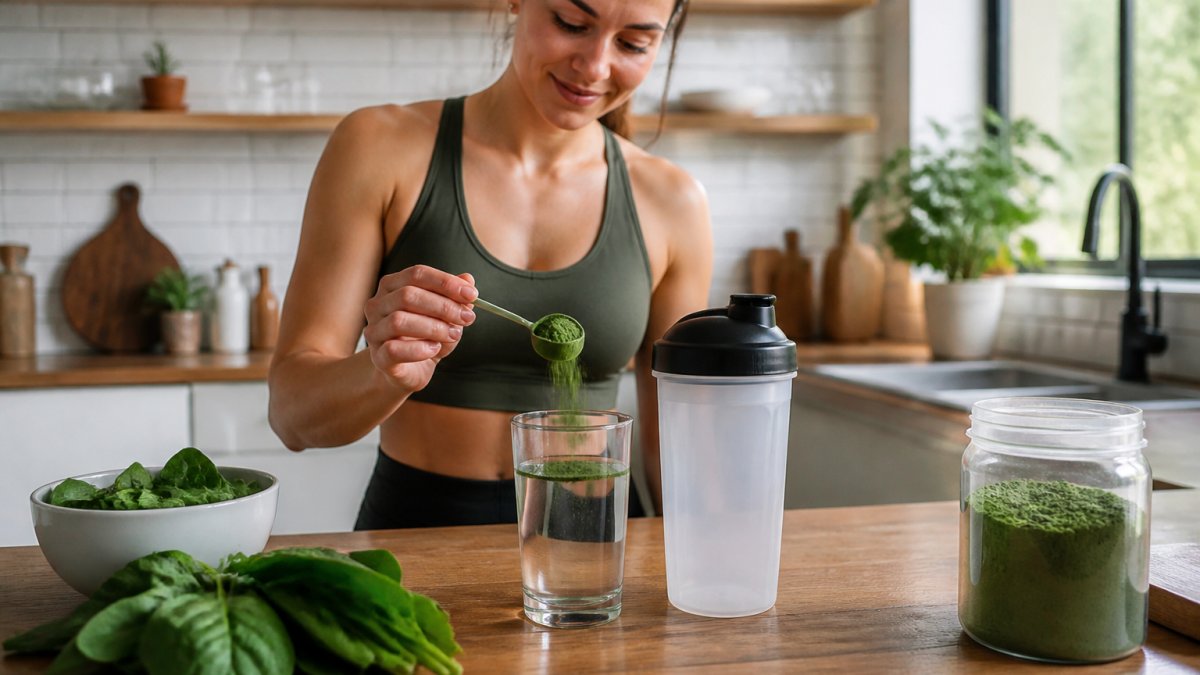
A common way to use greens powder is one serving a day, at a consistent time, mixed into 8 oz of water, juice, or a smoothie.
Choose a time you will actually remember
The most common pattern among people who stick with a greens powder is anchoring it to something they already do every day. Good anchors include:
- First glass of water in the morning: Easy to remember, and pairs well with an empty stomach if that suits your digestion.
- Breakfast or a morning smoothie: The powder blends into a meal you are already making.
- Mid-afternoon slump: A useful replacement for a second coffee or a sugary snack.
The specific hour matters less than tying the time to a trigger you will not forget, because the habit, not the timing, is what delivers the daily nutrition.
Mix it so you will actually drink it
A simple routine that holds up:
- Pick a trigger you already have, such as breakfast or your first glass of water.
- Add one scoop or one tablespoon to 8 oz of liquid.
- Shake or blend for 20 to 30 seconds to improve mixability.
- Drink it within a few minutes, before it settles.
- Store the container as the label directs, often in the fridge after opening.
Taste is the usual reason people quit. If plain greens are too grassy, blend with fruit, choose a flavored option, or mix into a smoothie with banana or berries. Readers with sensitive digestion should read our guide to supplements for sensitive digestive systems before starting a daily routine.
Set realistic expectations
Greens powder is best thought of as a nutrient top-up rather than a transformation, and whether it earns a permanent spot on your counter depends on whether the habit is sustainable.
What a scoop can do:
- Add vitamins, minerals, and plant compounds quickly
- Fit into a day when meals are rushed or repetitive
- Deliver nutrients in a form that is easy to absorb
What a scoop cannot do:
- Replace the fiber and volume of whole produce
- Stand in for a balanced diet over weeks and months
- Guarantee a health outcome on its own
Know the safety basics before you start
A few cautions are worth knowing before starting any greens powder:
-
Talk to a clinician first if you take medication, are pregnant or breastfeeding, or manage a health condition. Some ingredients, including certain herbs, algae, and concentrated plant extracts, can interact with medications or are not recommended during pregnancy.
-
Check for allergens. Formulas may contain gluten, soy, dairy, or other allergens depending on the blend, and "organic" does not mean allergen-free.
-
Do not use it to self-treat. A greens powder is not a treatment for a diagnosed deficiency or a medical condition.
Build the habit alongside whole foods
The practical answer is to use both. Keep vegetables as the base of your plate and let a greens powder fill the gaps on days when meals are rushed or repetitive. The CDC's national nutrition report tracks biomarker data on vitamins and minerals in the population, which is a useful reminder that nutrient gaps are common and worth addressing with food first.
Greens Powder vs Vegetables: What One Scoop Can and Cannot Replace
Greens powder vs vegetables is not a close contest. One scoop can add concentrated nutrients. It cannot replace the fiber, water content, chewing, and fullness of a plate of real vegetables.
What a scoop cannot do:
- Replace the fiber and volume of whole produce
- Stand in for a balanced diet over weeks and months
- Guarantee a health outcome on its own
The practical answer is to use both. Keep vegetables as the base and let a greens powder fill the gaps. If you want a deeper look at where supplements fit alongside food, the CDC's national nutrition report tracks biomarker data on vitamins and minerals in the population, which is a useful reminder that nutrient gaps are common and worth addressing with food first.
Choosing the Best Greens Powder for Your Dietary Needs
The best greens powder is the one whose ingredient list, serving size, and format match how you will actually use it. Match the product to your diet and digestion, not to the loudest claim on the label.
A quick comparison of what to weigh:
| Priority | What to check | Best fit |
|---|---|---|
| Broad blend | Greens, adaptogens, mushrooms, probiotics | Daily all-in-one routine |
| Gluten-free | Certified gluten-free, allergen-free | Celiac or sensitive digestion |
| Capsules | Serving size in capsules | Travel and no-mixing days |
| Algae-based | Spirulina and chlorella only | Simple, plant-based formula |
| Budget | Cost per serving | Starting a new habit |
For a broad daily blend, Catie's Organic Greens combines leafy greens, adaptogens, and mushrooms in a whole food powder. If you avoid gluten, Catie's Organic Gluten Free Greens is a gluten-free option. Prefer capsules? NXGEN Organic Grass-Fed Ancestral Leafy Greens is offered in capsule form. And if you want a minimal algae-based option, Perfect Aquatic Greens pairs organic spirulina with chlorella.


Start Your Daily Greens Routine with Nourishing World
The habit is the hard part, not the purchase. Pick one product that fits your diet, take it at the same time each day, and give it a few weeks before deciding whether it earns a permanent spot. Keep vegetables as the foundation and let the scoop do the gap-filling.
Nourishing World carries clean, organic greens powders rated 4.8/5 based on 217 reviews, with free shipping on orders over $45. Our range covers a broad whole food blend, a gluten-free formula, a capsule option, and a simple spirulina and chlorella powder, so you can match the product to your routine rather than the other way around.
Get started with Nourishing World and build a daily greens habit that fits your life.
Frequently Asked Questions
Is it okay to take organic greens powder every day?
Daily use is common for many people, but the right amount depends on the product and your needs. Keep the serving to the label amount: one scoop or one tablespoon, depending on the product. MD Anderson notes that greens powders can supply more nutrients than the body can safely use, so more is not better. If you take medication or manage a health condition, check with your doctor before making it a daily habit.
Can greens powder replace eating vegetables?
No. Yasi Ansari, a senior dietitian at UCLA, says supplements such as greens powders are not a cure-all for missing nutrients in your diet. A scoop adds concentrated powdered greens, but it does not deliver the fiber, water content, and chewing satisfaction of a plate of spinach or broccoli. Treat organic greens powder as a top-up on days when your vegetable intake falls short, not as a swap. Whole foods stay the base of daily nutrition.
What should I look for in an organic greens powder?
Start with the ingredient list: certified organic status, named greens such as spinach, kale, spirulina, and chlorella, and no artificial additives. Check the nutrition panel for calories per serving and fiber, which varies widely between products. A 2026 WIRED review listed one serving at 20 calories and 3 g fiber, while a Healthline entry showed 30 calories and 1 g fiber. Look for third-party testing and clear sourcing, and be skeptical of detox claims that go beyond what the label can support.
When is the best time to take greens powder?
Most labels, including Catie's Organic Greens, suggest mixing one tablespoon with 8 oz of water, juice, or milk and drinking it in the morning on an empty stomach for best absorption. The timing matters less than consistency: pick a slot you will actually keep, such as with breakfast or after a workout. If the taste bothers you on an empty stomach, take it with food instead. Store the container in the fridge after opening to preserve nutrients.
